Evidence
I learnt the craft on the ground — moderating groups, conducting interviews and ethnographies, observing people in context and learning to separate what was interesting from what was actually evidence.
Listen before you explain.
Charan Tadepally · Researcher · Strategist · Leader
I started by learning how to find evidence. Then how to tell its story, influence with it, grow people through it, build partnerships with it, and turn it into action. Somewhere along the way, I took “craft” quite literally. Then technology changed — and so did the questions I was asking.
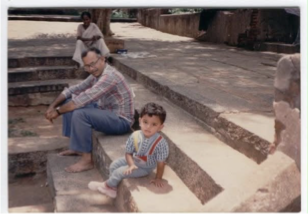
I grew up around a rural sociologist. Long before I knew there was a profession called research, I was already travelling, watching, listening and learning that behaviour only makes sense in context.
2010–2018
Before research became strategy, leadership or product building, I had to learn the fundamentals: how to listen, how to make sense of what I heard, and how to make somebody else care.
I learnt the craft on the ground — moderating groups, conducting interviews and ethnographies, observing people in context and learning to separate what was interesting from what was actually evidence.
Listen before you explain.
Advertising taught me that a good insight does not travel on evidence alone. It needs a point of view, a story and a reason for someone to remember it.
Evidence needs a story before it can move people.
Working across markets, brands and shopper contexts pushed me beyond reporting what I had learnt. Research had to help clients see the problem differently and make a better decision.
Insight earns its keep when it changes the conversation.
2018–2022
I stopped thinking only about doing good research. I began using the craft to grow researchers, build a business, earn client trust — and eventually drive action from inside the organisation I had spent years studying.
Built the qualitative research team from 3 to 10, combining junior and senior talent and creating hands-on ways to strengthen judgement: recruitment puzzles, storytelling exercises, group critique and two-way feedback.
The craft scales when you stop being the only person practising it well.
Flipkart became much more than an account. I worked across most of its major categories — mobiles, furniture, baby care and toys, grocery, large and small appliances — and grew from research supplier to trusted partner.
The work ranged from foundational category U&A studies to forward-looking questions: the influencer economy in 2019–20, mobile gaming and gamification, and a major brand equity and positioning programme that helped shape Flipkart's focus on “Bharat.”
The clearest proof of the partnership? The client eventually hired the researcher.
Once inside, the research study stopped being the centre of the universe. I could combine primary research with internal analytics, category data, behavioural signals, stakeholder knowledge and market evidence. There was no hierarchy to where insight came from; the question was what combination of evidence would get us closer to the right action.
Led large-scale segmentation programmes across Mobiles, Large Appliances and Small Appliances. In Mobiles, I challenged a segmentation that was difficult to activate and reframed it around variables the business could use — then connected those segments to behavioural data, workshops, concepts and product interventions.
Launched periodic brand tracks across Mobiles, Large Appliances, Small Appliances, Furniture, Beauty, Grooming and General Merchandise, evaluating the purchase funnel against key competitors and giving teams a recurring view of category health.
Explored what offline shopping provided that e-commerce did not — contributing to assisted shopping, vernacular voice, product comparison, AR/Flipkart Camera and differentiated premium shopping experiences.
At Nielsen, led a large brand equity and positioning programme for Flipkart that contributed to the organisation's strategic focus on “Bharat” — grounding positioning in a deeper understanding of the next wave of Indian consumers.
One mobile programme moved from segmentation → concepts → evaluation → launch.
These metrics belong to that specific programme — not to my Flipkart tenure as a whole.
Research became less about delivering the answer and more about creating the conditions for something to happen.
2022
After twelve years of researching people, brands and products, I took a sabbatical because I simply wanted to learn how to make furniture.
I could picture what I wanted to create. But carpenters worked in materials, joints, dimensions and mechanics I did not understand. To translate an idea into something buildable, I had to understand enough of their world to collaborate with them — without pretending to become the expert.
I thought I was learning to make furniture. I was also learning how to work meaningfully in a world whose technical language was not mine. A few months later, that lesson became unexpectedly useful.
2022–Present
I moved into product building just as technology itself was changing. Research became a way to explore experiences that did not yet exist — while keeping human needs, trust and value at the centre of increasingly intelligent systems.
I entered a world of engineers speaking CSS, Java, Python, APIs and ALM. The furniture lesson returned: I did not need to become an engineer, but I needed enough technical fluency to ask better questions and collaborate credibly.
I built the Power Pages research function at IDC and helped lead the product into AI — from low-code/no-code towards Copilot, vibe coding, smart-code and agentic experiences — across makers, professional developers, admins and end-browsers.
Where does AI fit in a developer workflow?
How should people interact with AI?
What do people expect from AI?
How should AI talk?
What happens when websites become intelligent?
What happens when assistants become agents?
Created ResearCharan to demystify research for PMs, EMs and Designers; founded the UXR Chaat Room to connect researchers across Microsoft India; experimented with creative participant recruitment; and brought behavioural frameworks such as COM-B, Maslow, AIDA and TAM into product conversations.
The technology kept changing. My job was to keep the human in the room.
The question evolved again. Once organisations can build AI, how do they know it matters?
My work examines how partners and customers move AI from ambition to implementation: AI value, ROI and baselines; adoption and measurement; AI Control Tower; Agent Studio; POC-to-production economics; governance; trust; evaluation signals and the metrics that make an AI investment defensible.
“Can we build it?” eventually becomes: “Should we build it this way, on this platform, at this cost — and how will we know it worked?”
Ask the journey
This first version is a guided explorer grounded in the story above. A live AI agent can be wired in later through a Cloudflare Worker and an LLM API.
The spine
The methods changed. The problems changed. The technology changed. The job remained remarkably consistent: understand people well enough to make better decisions.